Lead Acid Batteries: How Cheap Beat Cool at Google 65 comments
-
Font Size:
-
Print
- TweetThis
On April 1st CNET News published a story about a previously secret technology that Google (GOOG) has patented and implemented system-wide. The technology, which Ben Jai of Google reportedly described as their "Manhattan Project," builds a 12-volt battery into each server to provide backup power.
The point that fascinates me is Google's choice of small format valve regulated lead-acid batteries to keep its servers running. When an ultra-sophisticated company like Google picks cheap over cool for a mission critical function, I think it speaks volumes about the future direction of the energy storage industry.
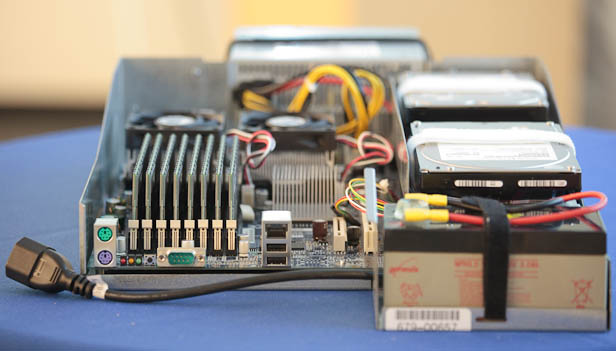
Stephen Shankland of CNET took the following rear-view photo of a Google server. The lead-acid battery is the small box on the lower right with the red and black leads. Similar batteries are readily available on the Internet for about $20.
![]()
Google's motivations for building backup batteries into its servers are obvious; reliability, cost-effectiveness and energy efficiency. Those same motivations drove the choice of valve regulated lead-acid batteries over a more exotic and expensive battery chemistry. I think Google's choice of lead acid batteries to support their mission critical server network provides a great backdrop for a reality check.
First, batteries are boring and as a user I just want them to work. Unfortunately, the only battery I've ever owned that delivered exactly what it promised was a Sears Die Hard I bought in the early '70s. I'm the first to admit that my cell phone and laptop batteries have improved a lot over the last 20 years, but my satisfaction to frustration index is still pretty close to even.
Second, batteries are stupid and the only thing they can do is store electricity in chemical form for future use. If the future use of the stored electricity is valuable to me, so is the battery. If the future use has limited value to me, so does the battery. In the final analysis, any discussion of battery value that is divorced from the specific needs of a particular user is meaningless. It's the usefulness of the electricity that creates the value, not the battery technology.
Third, batteries are fungible commodities that rarely inspire brand awareness, much less loyalty. I have no idea who made the batteries in my car, cell phone and laptop. I'll give long odds that you don't either. Since usefulness for a specific purpose is the only thing that matters to most users, the lowest cost producer of a competitive product will always establish the price.
Fourth, different ways of making the same type of battery are not critical intellectual properties. If several manufacturers make a comparable lead-acid, NiCd, NiMH, Li-cobalt, Li-manganese, Li-phosphate or Li-titanate battery, then nobody enjoys a meaningful technological advantage and the process patents are merely window dressing.
Fifth, small companies that try to run before they learn how to crawl invariably stumble, fall and get crushed by their customers. This is particularly true when a small company's target customers are giants. Bluster, trash talk, hype and drama may be appropriate as prelude to a WWE Championship, but they are deadly in business.
Sixth, energy storage needs do not fit neatly into a few cubby-holes and there are no universal solutions. So instead of a future where a few dominant competitors survive and the rest fall by the wayside, we are more likely to see dozens of strong competitors thrive by selling different technological solutions to discrete billion-dollar market segments.
In my third Seeking Alpha article I wrote:
"For better or worse, the world changed while most of us were busy making other plans. When waste was cheaper than conservation, waste ruled. Now that waste is getting painfully expensive and global energy demand is growing far more rapidly than supplies, we have a serious problem with no easy solution."
That dynamic is still the driving force behind energy storage decisions. Since reliable service is critical to its mission, Google needed to ensure that its servers would not go down in the event of a power failure. One could easily argue that reliability is so important to Google that backup power is priceless. But Google is well known for spending wisely and while any number of energy storage technologies could have served its purposes, Google picked the most affordable and environmentally friendly battery technology over several cooler technologies.
The energy storage sector can be very confusing for investors because of the political appeal of and media hype over plans to use Li-ion batteries in a new generation of plug-in electric vehicles. In an effort to milk the current irrational exuberance for all it's worth, many Li-ion battery developers swan around like minor princes gossiping about the king's impending illness and waxing prophetic on how marvelous things will be once they get government guaranteed loans to build U.S. factories, magically slash their production costs, find customers that aren't bankrupt or teetering on the brink of the abyss and triumphantly ascend to the throne. Since the politicians and press don't know any better, and the environmentalists are eager to embrace any feeble reed that might reduce carbon emissions, the meaningless forecasts of future victories are accepted as fait accompli despite the fact that the king is in fine shape and the minor princes have not shown any ability to lead, much less rule.
Batteries are a not a cause or a crusade, they're a business. Unfortunately for many investors, that message has been lost in the hype and created some incredible market distortions. If you compare market capitalizations, Ener1 (HEV) is almost as valuable as Enersys (ENS). If you compare financial statements, however, you'll find that Ener1 wouldn't qualify as a rounding error if it was part of Enersys. The distortions are every bit as striking if you make the same comparisons between Valence Technology (VLNC) and Exide Technologies (XIDE). Comparable distortions are obvious for late stage technology development companies like Altair Nanotechnologies (ALTI) and Axion Power International (AXPW.OB).
The realities of the battery industry are such that every survivor will prosper and have more business than it can say grace over, but it will take years if not decades for Li-ion developers to grow their businesses to the point where their fundamentals justify their market values. So while the currently unloved lead-acid battery companies are growing their businesses and increasing shareholder value, the minor princes are more likely to stagnate, stumble and fall.
When it came to a mission critical buying decision, cheap beat cool at Google. Does anybody really believe American consumers will act differently when it comes to their own money?
Disclosure: Author is a former director and executive officer of Axion Power International (AXPW.OB) and holds a substantial long position in its stock. He also holds small long positions in Exide Technologies (XIDE) and Enersys (ENS).
Related Articles
|


This article has 65 comments:
I gotta admit, I love it.
LOL (Long On Lead)
Frankly, John, your articles annoy me. I know I shouldn't get annoyed, but I am.
I have no problem if you insist on using acid-lead battery powered cell phone or laptop (carrying on these weights is good for health too, who needs a jym ?). But number of articles you published in just couple of month in favor of lead-acid batteries looks to me somewhat agonizing advocacy of must die technologies (althouh the word "technology" doesn't seems to be appropriate here).
You see, in many cases a horse is much more cost efficient technology than a car (dirt cheap production, virtually costless biofuel, etc.), so why don't you get one?
Even better, just sell your acid-lead stocks and pick another subject to spend your talent on.
My basic problem is 30 years of experience where laboratory science is rarely fails and the industrial engineering to take a science project out of the laboratory and bring it to a point where you have a product manufactured by guys in gimee caps rarely succeeds.
So while we praise the gee whiz science let's not lose track of the fact that we need to wake up tomorrow morning, go to work with the tools we have, solve our problems as best we can and be ready to embrace something better if, as and when it's perfected. Ultimately, our problems can't be solved by technologies that are too expensive today but may get cheaper in the future. We also can't afford to put anything on hold while we wait for solutions that may never arrive.
That being said, your annoyance does not change the fact that policy wonks who know little or nothing about technology are trying to change the course of a nation on the basis of PR, hype and irrational hope, rather than solid science.
Li-ion is great for portable electronics and expensive toys of all sizes – everything from game boys to PHEVs. But that doesn't change the facts that:
1. The difference between men and boys has always been the price of their toys;
2. Toys remain toys no matter how you justify them;
3. Moore's law does not apply to chemistry and the current battery technologies are never going to get much cheaper; and
4. Without cost-effective batteries, electric transportation will never be within the financial reach of the 90% of the population that use 90% of the gasoline.
Any updates on the stimulus grants regarding battery developers?
Any thoughts on rare earth metal suppliers for NiMHy batteries, such as Lynas?
Thanks
While I agree with you that Lead Acid is a dumb technology, you should know that our battery packs include (2) D9 ports and on-board battery diagnostics + a GlobeTRAC wirelss communication system - hardly a "dumb brick" like your precious Lead Acid product. These enhanced features not to mention a life cycle 50 times that of Lead Acid are what helps to explain the cost difference between Lead and Lithium but you have to understand that before drawing apples and oranges cost comparisons.
Don Harmon
I would suggest that you might want to check out page 17 of the following slide presentation from the DOE's 2008 Peer Review before relying on cycle life superiority.
www.sandia.gov/ess/Pub...
According to this DOE study at least, LiFePO4 has no cycle life advantage over the new generation of lead carbon. So if you want to compare your advanced battery, the least you can do is compare it with the best in class on the lead-acid side.
It all goes back to our last series of back and forth. There's no question in my mind that Li-ion will take the extreme performance tail of the bell shaped curve. But both of us know that it will never be a solid solution for the Joe Lunchbucket middle of the curve and the day to day applications like providing uninterruptible power for servers.
Is Google known for seeking "cheap" solutions?
Just an opinion(aka paultaut)
Don Harmon
On Apr 12 01:44 PM John Petersen wrote:
> Don, I'm delighted to see Google testing everything, but we know
> for sure the Li-ion alternative testing has not made it very far
> because nobody is trumpeting their relationship with Google. The
> lead-acid boys can be sanguine about business as usual sales that
> don't represent substantial revenues. The li-ion crowd, not so much.
> By the way, how does your pricing compare with VRLA?
>
> I would suggest that you might want to check out page 17 of the following
> slide presentation from the DOE's 2008 Peer Review before relying
> on cycle life superiority.
>
> www.sandia.gov/ess/Pub...
>
>
> According to this DOE study at least, LiFePO4 has no cycle life advantage
> over the new generation of lead carbon. So if you want to compare
> your advanced battery, the least you can do is compare it with the
> best in class on the lead-acid side.
>
> It all goes back to our last series of back and forth. There's no
> question in my mind that Li-ion will take the extreme performance
> tail of the bell shaped curve. But both of us know that it will never
> be a solid solution for the Joe Lunchbucket middle of the curve and
> the day to day applications like providing uninterruptible power
> for servers.
I'll not suggest that LiFePO4 can't match or perhaps exceed those numbers, but once you eliminate sulfation with a lead-carbon battery-supercapacitor hybrid, you end up with one of the most durable chemistries on the planet and a substantial increase in power because of the supercapacitance.
I don't try to apply Moore law to battery production. The production cost reductions would come simply due to mass production volumes. Since acid-lead products are already there, I don't expect their production costs to get any lower. Yet advanced battery technologies haven't reached truly MASS production. LCD technologies killed CRTs not because of Moore's law.
Speaking of automaker, Prius is not such an expensive toy (yet profitable), even taking in consideration that it uses not the best batteries on the market.
Speaking of numbers, by the way, I'm curious how much power is spent by lead-acid for carrying it's own weight ?
Also where are these Super Capacitance Lead Carbon wonders being used and what reports are there out there showing any EV Vehicles that use them right now?
Got AMPS ?
Don Harmon
Thanks! Good article, again!
I'll buy myself a Taddy Porter!
John - it amazes me less and less how much you cherry pick your data. These tests are also from over a year ago and the battery they used isn’t exactly from one of the companies who are doing the heavy development. These guys licensed the technology from Texas University and TU had their patent tossed in the UK and Valence Technology’s patents prevailed. I do believe lead acid technology is getting better (maybe even a lot better), but you simply refuse to think that the newer Lithium battery technology has any ability to improve. Why can a very old technology (lead acid) improve in your mind, but the new technology is suddenly frozen in one spot. You dish out a one sided story. You assume the best for lead acid and the worst for Lithium.
On Apr 12 04:57 PM John Petersen wrote:
> Don, the lead-acid with carbon additives rarely got past 1,500. The
> CSIRO-Furukawa ultrabattery with a carbon negative is shown on page
> 15 - left hand graph. Since the graph tracks the lead-carbon hybrid
> between 14,740 and 16,740 cycles, I would not be confident that LiFePO4
> can fairly claim a major cycle life advantage.
>
> I'll not suggest that LiFePO4 can't match or perhaps exceed those
> numbers, but once you eliminate sulfation with a lead-carbon battery-supercapacitor
> hybrid, you end up with one of the most durable chemistries on the
> planet and a substantial increase in power because of the supercapacitance.
>
Comparing Lithium Phosphate to Lead-Acid, or even Lithium-Ion is ridiculous.
The fact that Google puts a single lead-acid battery INSIDE each of their made-to-order batteries doesn't put a stamp of approval on an old technology, its simply reflects a) their server's 2-year life-cycle (low cost) and 2) safety.
1) Google doesn't need a computer or battery that lasts any longer, as they' replace with new, faster technology and throw 100's of old computers away.
2) Since Google has 1,000's of computer at each data center, Lithium Ion would not be a good choice, as a single shorted battery would spontaneously combust and burn the entire datacenter down (100's of Millions of dollars in capital and lost revenue)
Second - Google can throw away as many servers as they want to and keep the batteries as the life cycle for a backup LiFePO4 is 60 time that of a stupid Lead Acid brick. Why throw the baby out with the bathwater?
Don Harmon
On Apr 12 09:53 PM Pro-Engineer wrote:
> John - You just don't get it ...
>
> Comparing Lithium Phosphate to Lead-Acid, or even Lithium-Ion is
> ridiculous.
>
> The fact that Google puts a single lead-acid battery INSIDE each
> of their made-to-order batteries doesn't put a stamp of approval
> on an old technology, its simply reflects a) their server's 2-year
> life-cycle (low cost) and 2) safety.
>
> 1) Google doesn't need a computer or battery that lasts any longer,
> as they' replace with new, faster technology and throw 100's of old
> computers away.
>
> 2) Since Google has 1,000's of computer at each data center, Lithium
> Ion would not be a good choice, as a single shorted battery would
> spontaneously combust and burn the entire datacenter down (100's
> of Millions of dollars in capital and lost revenue)
and asking Li-ion advocates to show me exactly where the savings will come from. Those requests draw nothing but dead air. Until somebody can show me how the raw material costs can plummet in a commodity constrained world, I can't buy optimism that is not supported by economic reality.
Don Harmon, the only public price reference on the Ultrabattery is Sandia's July 2008 report on SEGIS-ES, which pegs the current cost of asymmetric lead-carbon at $500 ($250 in 10 years) and the current cost of $1,333 currently ($780 in 10 years).
www.sandia.gov/ess/Pub...
I have been told any number of times that Valence is selling battery packs at $1,000 per kWh, but they don't have any gross margin at that price point. So at least in the case of Valence, the price would be spot on the Sandia number if it added a normal markup.
There are a number of stories on the Ultrabattery but none go into the kind of detail I would hope to see in a full white paper. Some that I've noted in other articles are:
www.autobloggreen.com/.../
www.csiro.au/science/U...
www.csiro.au/resources...
I point to the Ultrabattery because it is basically a variation on the PbC battery-supercapacitor that Axion has been developing for the last five years. Some years back Axion made a tactical decision to avoid publishing performance data until a fully manufactured device was available. The reason was the disparity between laboratory results and factor results that I frequently write about. Since Axion will be putting its automated electrode fabrication lines into full scale production by the end of the current quarter, I expect detailed characterization studies to be available in a matter of months.
JKessler, for your particular application deep discharge is the critical metric. For others like grid stabilization rapid cycling at a partial state of charge is what matters. For others like the one highlighted in this article, months of boredom punctuated by moments of pure panic are what matters. It is unreasonable to believe that a single technology can be all things to all users, but that's precisely the story line we're getting from the lithium princes.
The engineers I've spoken to tell me that a 10% DOD from a 50% SOC will shred most batteries. But I agree wholeheartedly that no single report and no single metric does an adequate job of showing the value of a battery. That requires detailed side by side studies that dig down into every critical metric for every critical application. Since those studies have not been done, there are some massive holes in our current decision making matrix.
I understand that you think Valence is better than A123, but UT's patent litigation is not proof of a substandard product. In defense of A123, I would merely point out that they're the one who made it through Chrysler's due diligence process; not Valence.
Lead-carbon is a whole new class of device that eliminates the primary failure mechanism in lead-acid chemistry; by definition a disruptive advance resulting from a radical design change. Similar advances might indeed be possible with Li-ion, but I can't see any on the horizon. In the absence of a disruptive advance, existing Li-ion and lead acid technologies are in the same boat, they are mature technologies that can improve over time but are not likely to get much cheaper.
I think our basic problem is that we're talking past each other. You tell me what a technological wonder the li-phosphate is and I take your word for it. I tell you that li-phosphate is too expensive for 90% of Americans and the prices are not likely to decline, and you go back to how wonderful the technology is. All I care about are the future sales, profits and stock prices. Those come from a quality product that is affordable for the mass of consumers. Li-phosphate has the quality product part down pat, but unless I'm missing something it will never reach the point of mass market affordability.
Speculawyer, I don't think we'll have any idea about what the best applications will be until the devices are tested in all those applications. Happily, it's a target rich environment out there. There will be some applications where lithium works best and others where lead or zinc or something else works best. Unfortunately, the market perception right now is "there can be only one" and that is simply not the case. That dynamic has resulted in a situation where the lithium princes are grossly overvalued in the market and everybody else is undervalued.
Pro-engineer, you've made my point even though you didn't intend to. Every buyer is going to choose his storage technology based on his particular needs for a particular application and when two technologies are capable of serving the same needs, the cheapest will typically win the battle of the wallet.
Don Harmon, isn't claiming a 120 year life (60x 2 years) a bit aggressive for a battery technology that you and others keep telling me has only been around for a couple years?
As far as mass production of lithium phosphate batteries, when did that become a reality? I think it is getting close to happening, but I don’t think you can say that this new type of battery is being mass produced. After all, you have to have mass orders to have mass production and that is only beginning to happen.
As far as the car companies go, I wouldn’t put much value in their due diligence process. Chrysler and GM are going to be lucky if they come out of this recession as a viable company. I hope they do succeed, because as a US tax payer it would be nice not to have to pay for a loan I didn’t agree to make. Ford is the only car company that is on a semi-solid footing and they are partnering with Smith Electric Vehicle and an OEM car manufacturer. Smith uses Valence’s batteries and the OEM car company is testing Valence’s batteries. The new two wheeler GM and Segway just introduced at a car show uses Valence’s batteries.
The question is whether Li-phosphate is truly a new product from a manufacturing perspective, or simply a series of materials changes in an existing product. My sense is that changing the chemistry in a pre-existing class of batteries will be a far simpler task than designing a new class of batteries and manufacturing methods from the ground up.
As I understand the generic product class known as Li-ion batteries, the production equipment, cases, separators tabs, other internal components and basic manufacturing processes don't change much. But I don't have enough detailed knowledge one way or the other to be confident in a conclusion.
The reason is the process is different and the main thing is the size factor of making large format Lithium Iron Phosphate or other flavors. These new sizes are required for scaling up to EV's from laptops which is why you need new factories. Until now all of the large format Cells has been basically a handmade operation - which is why you see the dominance of Asian companies doing the manufacturing to date.
Therefore we haven't seen the mass manufacturing of large format Lithium Cells YET so it's hard to play the cost factors NOW. Once large OEM orders (like Chrysler) and others come on-line and we have some modern robotic large format mfg. lines with high volumes of Cells being made - then I would expect you will see a dowward curve in the cost that you harp on all the time.
Furtermore there are also key differences in manufacturing prismatic vs. cylindrical large format batteries. I can go into that later.
Don Harmon
I would like to point out, however, that it is much easier to believe your assertion that "Once large OEM orders come on-line and we have some modern robotic large format mfg. lines with high volumes of Cells being made - then I would expect you will see a dowward curve in costs" is much easier to believe than the urban legends of imminent cost declines of 50% or more.
On Apr 12 10:17 PM Don Harmon wrote:
> Correction - Lithium Iron Phoshphate (LiFePO4) batteries do not spontaneously
> combust, burn, or explode like the Lihium Cobalt batteries do for
> starters. They are completely safe and proven so by Sandia and many
> other laboratories.
>
> Second - Google can throw away as many servers as they want to and
> keep the batteries as the life cycle for a backup LiFePO4 is 60 time
> that of a stupid Lead Acid brick. Why throw the baby out with the
> bathwater?
>
> Don Harmon
>
IF they did electr to recycle and re-use their batteries, Lithium-Ion-Cobalt is not a contender, as it is unsafe. This leaves us with Lithium-Ion-Phosphate, which VLNC owns the patent rights to.
On Apr 13 01:00 AM John Petersen wrote:
> Evil Dragon, you make it sound like Li-ion is the brand new kid on
> the block when the fact is that several billion dollars of Li-ion
> batteries are made every year and they dominate the portable device
> markets. THAT IS MASS PRODUCTION NOW. Just as good science does not
> make conclusions based on simplified extrapolation of previous dynamics,
> neither does good business. Batteries are a commodity intensive business
> and the immense bulk of the cost savings that can be realized have
> been. I keep pointing to cell cost studies like www.transportation.anl...
>
> and asking Li-ion advocates to show me exactly where the savings
> will come from. Those requests draw nothing but dead air. Until somebody
> can show me how the raw material costs can plummet in a commodity
> constrained world, I can't buy optimism that is not supported by
> economic reality.
>
> Don Harmon, the only public price reference on the Ultrabattery is
> Sandia's July 2008 report on SEGIS-ES, which pegs the current cost
> of asymmetric lead-carbon at $500 ($250 in 10 years) and the current
> cost of $1,333 currently ($780 in 10 years).
>
> www.sandia.gov/ess/Pub...
>
>
> I have been told any number of times that Valence is selling battery
> packs at $1,000 per kWh, but they don't have any gross margin at
> that price point. So at least in the case of Valence, the price would
> be spot on the Sandia number if it added a normal markup.
>
> There are a number of stories on the Ultrabattery but none go into
> the kind of detail I would hope to see in a full white paper. Some
> that I've noted in other articles are:
>
> www.autobloggreen.com/.../
>
> www.csiro.au/science/U...
> www.csiro.au/resources...
>
> I point to the Ultrabattery because it is basically a variation on
> the PbC battery-supercapacitor that Axion has been developing for
> the last five years. Some years back Axion made a tactical decision
> to avoid publishing performance data until a fully manufactured device
> was available. The reason was the disparity between laboratory results
> and factor results that I frequently write about. Since Axion will
> be putting its automated electrode fabrication lines into full scale
> production by the end of the current quarter, I expect detailed characterization
> studies to be available in a matter of months.
>
> JKessler, for your particular application deep discharge is the critical
> metric. For others like grid stabilization rapid cycling at a partial
> state of charge is what matters. For others like the one highlighted
> in this article, months of boredom punctuated by moments of pure
> panic are what matters. It is unreasonable to believe that a single
> technology can be all things to all users, but that's precisely the
> story line we're getting from the lithium princes.
>
> The engineers I've spoken to tell me that a 10% DOD from a 50% SOC
> will shred most batteries. But I agree wholeheartedly that no single
> report and no single metric does an adequate job of showing the value
> of a battery. That requires detailed side by side studies that dig
> down into every critical metric for every critical application. Since
> those studies have not been done, there are some massive holes in
> our current decision making matrix.
>
> I understand that you think Valence is better than A123, but UT's
> patent litigation is not proof of a substandard product. In defense
> of A123, I would merely point out that they're the one who made it
> through Chrysler's due diligence process; not Valence.
>
> Lead-carbon is a whole new class of device that eliminates the primary
> failure mechanism in lead-acid chemistry; by definition a disruptive
> advance resulting from a radical design change. Similar advances
> might indeed be possible with Li-ion, but I can't see any on the
> horizon. In the absence of a disruptive advance, existing Li-ion
> and lead acid technologies are in the same boat, they are mature
> technologies that can improve over time but are not likely to get
> much cheaper.
>
> I think our basic problem is that we're talking past each other.
> You tell me what a technological wonder the li-phosphate is and I
> take your word for it. I tell you that li-phosphate is too expensive
> for 90% of Americans and the prices are not likely to decline, and
> you go back to how wonderful the technology is. All I care about
> are the future sales, profits and stock prices. Those come from a
> quality product that is affordable for the mass of consumers. Li-phosphate
> has the quality product part down pat, but unless I'm missing something
> it will never reach the point of mass market affordability.
>
> Speculawyer, I don't think we'll have any idea about what the best
> applications will be until the devices are tested in all those applications.
> Happily, it's a target rich environment out there. There will be
> some applications where lithium works best and others where lead
> or zinc or something else works best. Unfortunately, the market perception
> right now is "there can be only one" and that is simply not the case.
> That dynamic has resulted in a situation where the lithium princes
> are grossly overvalued in the market and everybody else is undervalued.
>
>
> Pro-engineer, you've made my point even though you didn't intend
> to. Every buyer is going to choose his storage technology based on
> his particular needs for a particular application and when two technologies
> are capable of serving the same needs, the cheapest will typically
> win the battle of the wallet.
>
> Don Harmon, isn't claiming a 120 year life (60x 2 years) a bit aggressive
> for a battery technology that you and others keep telling me has
> only been around for a couple years?
In the real future market for energy storage devices where every battery producer will have more business than he can say grace over, I have a hard time justifying a price of 9x sales for Valence when I can buy Exide for 0.1x sales.
Pro Engineer - Again you are wrong. The University of Texas holds the patent rights on Lithium Iron Phosphate as invented by Dr. John Goodenough who also invented the original LiCO2 (Lithium Iron Cobalt Oxide battery. These rights were purchashed by Hydro Quebec in Canada 15 years ago and are currently being litigated by Phostech Lithium, a subsidiary of Sud Chemie in Germany. Phostech has an ongoing patent dispute against A123, Valence, and Black & Decker who makes the DeWalt line of power tools.
John Petersen- You are correct about these magic numbers. My own people won't even tell me because they think I talk too much as it is....and all I always preach the fallacy of a 50% reduction in Lithium - ion prices on other forums much to the dismay of the masses who predict a precipitous fall in prices is imminent. The key to all of this is simply that low Lithium prices are a myth. The average consumer just is not going to see the prices of Lithium-ion battery products drop to the level of flashlight or camera batteries. In other words he/she will not be able to buy one pack at the supermarket.
Where we will see significant price points drop will be for very high-volume OEM accounts where the customer is purchasing in quantities of 1,000 - 10,000 + complete battery packs at a time. This is where you will see the price point come down possibly as low as 40% off of "Retail".
The real future for Lithium - ion is to build it into finished products and not to try to market individual Cells. Doing otherwise is to commoditize Lithium - ion which really cannot be done due to many of your own arguments. This won't stop some from trying however.
Don Harmon
On Apr 13 01:20 PM Pro-Engineer wrote:
> And you sir, have proven mine. Google is NOT interested in the longevity
> which Lithium Ion provides. GOOG simply needs 2-year capable, cheap
> storage.
>
> IF they did electr to recycle and re-use their batteries, Lithium-Ion-Cobalt
> is not a contender, as it is unsafe. This leaves us with Lithium-Ion-Phosphate,
> which VLNC owns the patent rights to.
Don Harmon
I'll let you and Pro-Engineer duke it out over who has what patents and how valuable those rights may be. Patent law is one of those things that I always turn over to my betters.
Pro Engineer hasn't a clue about the patent wars - i recommend he go to this wiki link and bone up on the history : en.wikipedia.org/wiki/...
I learned a long time ago that a patent just entitles you to a lawsuit. Personally I believe in the concept of "first mover advantage" and let the IP people worry about the rest.
Don Harmon
Every chemistry has it's niche. For a stationary application where weight doesn't matter and the discharge cycles are infrequent and not deep, guess what - VRLA is very cost effective. From a reliability standpoint, they require periodic monitoring / maintenance for mission critical applications like nuclear power plants where they power up the control room after a cold start. They're as big as a small school bus. Surprisingly, they don't crank the very big diesel electric generators to boot up the rest of the plant, compressed air into the cylinders does that in seconds.
Reminiscent of the starter battery in a car without the cranking need.
I recently took a tour through a major metropolitan Internet server farm sitting right on a major trunk. They had a similar setup. Large VRLA bank with many monitors and a small CAT diesel-gen setup out back.
What do these applications have in common? The VRLA batteries are watched extremely closely. I can't tell you how many buildings I've been in with many backup LA battery emergency lites that are dead when the power goes out. Excellent way to check maintenance priority.
How would the high discharge frequency of a large utility load leveling application would affect battery life? The discharge depth is a function of the size of the battery bank. Any idea what the economics are?
So I wonder what Google has incorporated into their patented server backup VRLA technology to monitor and warn users that the promised power is still available.
What I'm really waiting for is energy storage technology for all electric cars. Hybrids are too expensive and complex with an aux IC engine. My next car will be an around town all electric commuter.
Don Harmon
LOL. Since my current car is an 88 Civic with 275K miles, that shouldn't be a problem. Inn fact, the last time I checked the Web, there are alot of DIY kits out there for converting cars like this to all electric.
On Apr 13 02:23 PM Don Harmon wrote:
> Sorry, Pro Engineer - Phostech Lithium & UT board of Regents
> own the original patent rights to LiFePO4. All Valence and A123 have
> are claims to "cathode improvements" and since they have failed to
> pay the inventor any royalties means they may have to do so once
> the patent office complete their review and hands down a decision.
>
>
> Don Harmon
I've cleared my calendar to listen to the conference call at 1:00 p.m.
The comments of Mr. DePew seem to support most of what Mr. Peterson has been saying about the relative cost of technologies. I think the new generation of LAB using carbon anodes (Firefly) and capacitor type hybrids (CSIRO and Axion) will all be huge success for storage where price is key and weight/size are less important. Lithium will rule where weight and size are critical and price is less so. The interview can be heard at www.evcast.com.
The 30% uptick in axion's stock price this morning sure leads one to believe that the conference call will be good news. I am curious. Would you consider Axion a "high tech" company which will have a higher PE ratio than an "old line" manufacturing company. Even though there technology is new (nano) I don't see tech breakthroughs on a regular basis. How do you see the future for this company?
Futurist, it will be very interesting to see how the market classifies Axion. There was never a question about whether the technology worked. The real issue was taking it from the laboratory to a factory and doing that in a way that would allow implementation in all existing battery plants, instead of just our battery plant. By the time I resigned as chairman, we had an electrode assembly design that would work as a plug-and-play replacement for conventional lead-based negative electrodes. From there, we had to design, build and test automated equipment that would make a consistent product that met all applicable performance and QC specifications. In the last conference call, Mr. Granville explained that the automated electrode fabrication line was built and running at the equipment designer's facility in California. He also explained that the electrode assemblies were passing quality control testing and being built into PbC batteries - the first fully manufactured devices.
I've always been excited about the potential here because if the manufactured PbC devices perform like the prototypes, ramping up production will only require Axion to build new electrode manufacturing equipment based on a proven design and put them into production. From there, it can ship the electrode assemblies to any battery plant in the country for incorporation into co-branded devices. In the end, its a bit like Intel's business plan where as long as they get to make the processor, the identity of the computer manufacturer becomes almost irrelevant. If the plan works the way we developed it, there is no telling how the market will react.
Isn't this partnership highly accretive for XIDE as well? I can understand the drastic jump in AXPW due to its relatively low liquidity and speculative nature. But shouldn't XIDE get some bump from this as well? From what I understand, they are going to be the sole benefactors (at least for a while) of AXPW's technology?
Wouldn't this be the same as Hewlett Packard having signed an exclusive deal with Intel to be its sole manufacturer back when its first microprocessor hit the market? Maybe the technology isn't as revolutionary, but it seems like the stock should at least be up today, no?
TIA!
MM
mikebrah, I think it will be very good for Exide which is woefully undervalued anyway. Unlike other advanced battery technologies that will take years to build plants and begin production, the things Axion has been developing can be implemented very rapidly with little or no modification to existing manufacturing infrastructure.
I'd encourage you to listen in on this afternoon's conference call.
You click open a memory file from a recent incident.
You reminded of when I saw the batteries being serviced on the backup system to the emergency exit lights and fire alarm at work.
I asked the engineer when they renewed the batteries, his response was "when they don't hold a charge"
To my question "how long do they last" I was asked "how long is a piece of string"
Guess what the batteries to this critical system were?
I remember at the time thinking I know someone who has asked for details on how long batteries last, sorry for the delay.
Don Harmon
On Apr 13 09:32 PM jkessler wrote:
> Sorry Don I believe you are incorrect about the patent. The first
> patent issued and filed in the US patent office for Lithium Phosphate
> batteries is to Valence Technology. I don't usually believe what
> I read, so I spent too much time looking up the patents myself. The
> Prof's patent for Lithium Phosphate comes after Valence’s Patent.
> Phostech and UT already lost the patent lawsuit in the UK.
Very interesting conference call. I like the fact that ,for the immediate future, Axion has all of the plant facilities it needs in place. I'm also impressed that Axion now doesn't need to build a sales force ( an expensive propostion). Exide already has an underutilized force ready to sell product. What a win/ win situation. I guess that snails pace I refferred to earlier has sped up a bit.
Thanks for the good information in all of your articles.
Valence Phosphate Patents
Patent 5,871,866 – Filled September 23, 1996 – Patent Issued February 16, 1999
Patent 5,908,716 – Filled April 15, 1997 – Patent Issued June 1, 1999
Goodenough
Patent 5,910,382 – Filled April 21, 1997 – Patent Issued June 8, 1999
Maybe your article is more accurate than my information.
On Apr 14 12:53 PM Don Harmon wrote:
> www.marketavenue.cn/up...
>
>
> Don Harmon
www.saftbatteries.com/...
On Apr 13 01:20 PM Pro-Engineer wrote:
> And you sir, have proven mine. Google is NOT interested in the longevity
> which Lithium Ion provides. GOOG simply needs 2-year capable, cheap
> storage.
>
> IF they did electr to recycle and re-use their batteries, Lithium-Ion-Cobalt
> is not a contender, as it is unsafe. This leaves us with Lithium-Ion-Phosphate,
> which VLNC owns the patent rights to.
seekingalpha.com/artic...
will make my views pretty clear as well as provide the reasons for my beliefs.
I just want to comment on Axion's business plan. You have done a great job of laying out their goals but for a fledgling company execution is everything. I see the Exide contract as a true long term partnership. Exide could have asked for the "electrodes only" now.
Instead Exide allows Axion to first maximize its manufacturing facilities. This ensures long term growth for Axion and gives Exide a technology edge. No R&D for Exide. Just Axion patent protection. I am very excited about the future for Axion. Thanks for the heads up.
On Apr 15 07:22 AM John Petersen wrote:
> Matt_the_Batt, it's even good news for Li-ion skeptics like me because
> repurposing an existing plant is far cheaper than building a new
> one from the ground up. I've always shied away from commenting on
> JCI because it's so terribly diversified and SAFT because it's so
> terribly French, but they're both fine companies with long-established
> manufacturing expertise in the sector. They also carry much more
> reasonable valuations than some of the princes.
Speculawyer, when I was but a lad, one of my Dad's companies owned a foundation patent for the blow-molded one gallon plastic milk bottle with an integrated handle. The idea caught on like wildfire and every plastic company in the country started making their own versions. When it came down to a choice between hiring an army of lawyers to file hundreds of lawsuits and abandoning the patent as worthless, Dad chose option B.
Fututrist and sticktoitiveness, an easily missed factoid is that Axion actually has two alliances with first tier U.S. battery manufacturers, not one. Exide is the new partner and has agreed to work exclusively with Axion in the lead-carbon space. East Penn Manufacturing has been a strategic partner for several years, is the OEM buyer on the $6.4 million contract announced last year, and is an excluded party under the Exide agreement, meaning Axion can continue the business relationship as usual. East Penn is also the US licensee for the Furukawa Ultrabattery technology. But I agree the call went very well.
your not stupid, so im sure you know this but didnt mention this and explain this for obvious reasons... please dont do that... :)
most people on here are far too smart to fall for this
seekingalpha.com/artic...
I believe cars with plugs will prove to be an economic disaster unless something entirely new and different emerges on the scene. But if we have to use batteries in transportation, and the current public mood certainly seems to favor that particular insanity, then the batteries need to be used where they'll have the biggest impact on U.S. gasoline consumption. That comes from electrifying gas guzzlers, not cars that would be very fuel efficient in any event.
In applications where small and light don't matter, lead is and will always be the battery of choice.