Seeking Alpha
Author's websites: By this author:
Submit
an article to

In Part I of “The Gaping Hole”, I stated that “the valid argument against massive future inflation is the fact that this bailout money must eventually end up not just in the monetary base but in the monetary supply.” When money in the monetary base is converted to monetary supply then this indeed causes velocity as the institutions that store the monetary base (the banking system) have the ability to leverage this base by up to 100 times the amount of money represented by the monetary base (Not 10 times as many people erroneously believe that the RRR in the U.S. is 10%. For a full explanation of the degradation of reserve ratio requirements to zero for many U.S. banking accounts, please reference this article here).

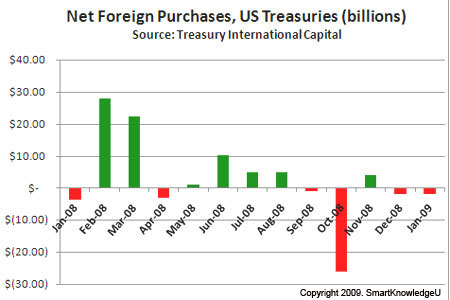
Thus, the proponents of the prolonged deflation argument suggest that significant acceleration in money velocity is years away. Here’s why they are wrong. The U.S. government has been creating debt for many years now at a faster rate than they can service it. Normally the U.S. issues more U.S. Treasury debt to foreign nations to receive more dollars in order to service their existing debt. As you can see from the U.S. Treasury’s own data below (the most recent data provided has a two-month time lag, thus the reason the charts stop as of February 2009), net foreign purchases of U.S. Treasuries which were a positive $28 billion as recently as March of 2008, have now been in a negative trend for five months now.

Considering it is safe to assume that foreigners have been net sellers of U.S. Treasuries in March and this month as well, this trend has now extended to 7-months. If the U.S. Treasury can not obtain enough dollars from Treasury bond and note auctions, then they must eventually ask the U.S. Federal Reserve to print more dollars out of thin air to service their existing debt because if the U.S. Treasury defaults on interest payments of Treasury bonds or notes, this event would be catastrophic.

If the trend of net selling of Treasury bonds by foreigners continues, as seems highly likely, this will contribute to the acceleration of money velocity in the near future as it is likely that an increase in dollars in the monetary supply will work their way through the fractional reserve banking system to be multiplied into greater amounts.

However, even in the absence of accelerating money velocity, the mere expansion of monetary supply indeed causes inflation. I have seen many people fall victim to believing tenets and principles just because they are contained in books or in newspapers, though history has proven that many principles believed for decades and even centuries were complete shams propagated by people with hidden agendas. Many people can not even properly define inflation. Rising prices do not cause inflation but inflation is rather caused by an increasing monetary supply.
foreignustreas

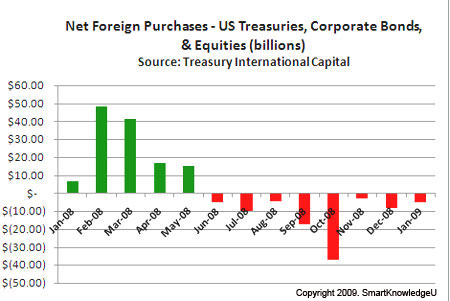
Furthermore, as I predicted over a year ago in this video I released in April of 2008, though virtually every talking head on TV disagreed with my views back then, I stated that foreign purchases of U.S. Treasuries, corporate bonds and equities would soon turn negative and that foreign capital would withdraw from U.S. markets in large quantities. At the time I made this prediction, net foreign capital inflow had been very healthy at $41.3 billion in March of 2008 and even healthier at $48.4 billion for the prior month.

Just three months after my prediction, foreign appetite for dollar denominated bonds and equities fell off a cliff as foreigners determined that the risk of buying assets denominated in U.S. dollars outweighed the rewards. In the below chart, we can see that for eight consecutive months, foreigners have been pulling capital out of the United States. If this trend occurs, as again seems highly likely, markets will soon be flooded with U.S. dollars, again accelerating money velocity.
foreigntotal

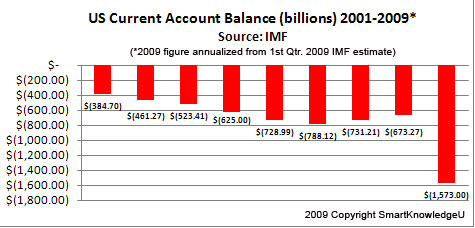
Currently, the saving grace that is preventing accelerating money velocity at this point is the unprecedented current account deficit that the U.S. maintains. This deficit, estimated by the IMF to already by $393.25 billion as of April, 2009, already exceeds the entire U.S. current account deficit for all of 2001 (-$384.70 billion). Of course, if one adjusts the IMF 2009 April estimate for inflation, then this number would not exceed the 2001 deficit, but nonetheless, it is a huge number for the 1st quarter 2009 that illustrates the U.S. is importing far more goods and services than it is exporting.

Consequently, the net current account deficit that the U.S. maintains has countered some of the increases in U.S. dollar supply created by the aforementioned two situations. China on the other hand, has a huge current account surplus because it exports far more goods and services than it imports.

dollar inflation

However, if we look at the long-term picture as illustrated in the chart below, it is evident that we are on track this year for a record annual current account deficit. The question is if the extrapolated figure will actually be realized. If indeed we proceed to reach the extrapolated figure on the below graph, then indeed accelerating money velocity will not materialize. But if we realize this unprecedented current account deficit, then this spells doom for the U.S. economy.

Will Barack Obama accept a collapsing U.S. economy in the first year of his new administration? Furthermore, if the U.S. Federal Reserve wishes to manufacture deflation, then doing so will cause a lose-lose situation. If the U.S. economy survives on imported goods and services, then millions of additional Americans will lose their jobs as the U.S. job sector continues to contract. As the job sector continues to contract, then U.S. dollar denominated bonds and equities will continue to lose value, foreigners will continue to dump these instruments, and the resultant flood of U.S. dollars will counteract deflation.
US deficit

The U.S. Federal Reserve has already tipped their hand with their willingness to expand the monetary base at unprecedented rates. The choice will soon come down to throwing bad money after bad money and the inflation of the monetary base to ridiculous levels (which eventually will translate into enormous increases in the monetary supply) or economic collapse and very angry and perhaps rioting citizens.

In the end, as I stated above, for massive inflation to occur, the “bailout money must eventually end up not just in the monetary base but in the monetary supply.” When we look at the choices for the future, I firmly believe that the U.S. Federal Reserve, as it has since its inception in 1913, will choose to sacrifice the U.S. dollar and massively increase monetary supply by any means necessary.

Print this article with comments
Comments
19
Comments 1 - 19 out of 19
You are viewing the latest 20 comments
  •  
    Politically speaking, Obama should probably make all the hard economic choices in his first two years and show a nice rebound in the second 2 years. So far he's not doing so as reflected in the massive bank infusions and deficits which to a great degree is the legacy of Bush Jr.'s failed term in office.

    The choices to get the economy moving if these measures fail will be drastically inflationary. Thus I agree that deflationary concerns take a back seat, unless you mean personal balance sheets. As you mentioned, the Fed's balance sheet is expanding as is the governments, but income and wages are faling still.

    This should be deflationary and supply and demand should create a new equilibrium. That is why people are so confused. We are toying with the natural order of the market, so market signals are getting quite hard to correctly read because the market itself is being distorted. You are right that we should second guess basic economic assumptions, the distortion we are seeing is currency debasement through government intervention.

    Japan has proven once a government steps off the cliff into quantitative easing politically there is no turning back. And the results so far are always bad. However, unlike Japan, rather than a stable currency we are likely to see a continuous currency debasement as demands that the Fed keep expanding it's balance sheet and keep artificially low interest rates even in the face of inflation continue. The worse the recession becomes the more the demands that we economically hang our currency out to dry will be.

    Eventually we need a Volker type response. Pay a heavy price now so we can come out of this mess strong and healthy later. This is what I'd like to see happen but I'm not. Rather we are still saying the economy is fundamentally strong if people would just keep spending themselves into economic oblivion. This is not defationary.
    Apr 26 05:46 AM | Link | Reply
  •  
    deflation follwed by massive inflation. has a nice historical ring of warning only i think the terms were expansion and contraction. this has been layed out in just that frame. it will all be done in concerted control. i don't think so. it will be always a little to late and the prediction of the banksters (the banking cartel aka the fed) ending up with the property and assets will be done as predicted/warned. it will be done in the name of helping us.
    mr. kim thank you once again.
    Apr 26 09:11 AM | Link | Reply
  •  
    Thank you for the thoughtful article. In my humble opinion, I see at least three factors, which is leading our Govt to intentionally create inflation:

    (1) Govt. perceives the economic problems mostly from a bank's perspective looking at the drop in home prices. Thus, those in power desire inflation to increase home prices and fix bad loans. Of course, this perspective neglects fundamental problems with national productivity, debt and unemployment.

    (2) Everyone wants to refight the Great Depression, without recognizing differences or studying other historical examples (like the Weimar Republic in Germany after WWI). It's like the Fed only knows how to get out the "play-book" (written for a game that was lost 70 years ago) and follow its instructions. There doesn't appear to be much creative thought on addressing the actual crisis at hand.

    (3) The ever-rising national debt will be much harder to pay back without inflation.

    Thus, even though salaries may be dropping, and jobs are still being lost, those deflationary trends will not overcome the inflationary forces caused by our head-in-the-sand economic policies. The U.S. dollar enjoys a big advantage over other currencies right now. But if squandered or abused, that advantage won't last forever.
    Apr 26 09:37 AM | Link | Reply
  •  
    This country does not have the balls to make hard choices. We are to fat, lazy, stupid, and arrogant. What we will do is inflate our dollars, sell everything we have than have Obumba beg for more loans. He makes a great beggar now that he has replaced Chamberlain as the great appeaser and ass kisser in modern history. Enjoy yourselves and eat and drink like the Romans, because it's all going to pass replaced by our young being in economic slavery. Now thats change you can believe in!
    Apr 26 10:10 AM | Link | Reply
  •  
    Excellent article. Thank you. Inflation is preferable to deflation. The deflation hawks are in control and the Fed is responding predictably. Every possible tool will be used to fight deflation. The result should be inflationary, but when and how much? The massive deleveraging of foreign held treasuries coupled with the grotesque unfunded entitlements may well result in a catastrophic default.
    Apr 26 10:24 AM | Link | Reply
  •  
    Good article, and I think Mr. Kim's analysis is basically correct. There are two culprits that need to be named here if we are ever to have hope of breaking the increasingly disastrous business cycle: government intervention in the markets, and Keynesian economic policy. Unfortunately, Keynes is still the favorite economist of the ruling class after all these years (and all the failures) precisely because he advocated heavy government interference in the market. The central bank cartel is indispensable to Keynesian economic policy.

    The solution should be obvious, and no, it's not a restoration of Volcker's policies. The Federal Reserve must be abolished, and the government forced to relinquish its control of the money supply. The way to do this is to let private entrepreneurs create competing forms of money, and let the markets decide which is best. Commodity-backed money would most certainly prevail. Whether or not bankers should be allowed to use fractional reserve lending (with full transparency) should also be left up to the markets.

    All of these ideas are fully explicated by the Austrian school of economics - the only real economics. Read all about it at mises.org.
    Apr 26 10:51 AM | Link | Reply
  •  
    Very interesting article --

    One thing that I don't understand is *why* will the massive $1.5-Trillion current account balance deficit cause inflation???

    I would think that all those dollars going overseas would cause, if anything, deflation here in the U.S.

    Is it because most of those dollars will be converted into other currencies and the dollars will flow back to the U.S???
    Apr 26 11:36 AM | Link | Reply
  •  
    I agree with you 100% Glen L.
    Apr 26 11:47 AM | Link | Reply
  •  
    The only question I have is: how is this relevant to "debt deflation"? Basically overleveraged asset values are "underwater," which means depreciating asset values are deflating due to excessive debt (and increasing debt-to-equity ratios). The inflation you refer to would actually be a result of a de facto currency devaluation. We'll see.
    Apr 26 12:52 PM | Link | Reply
  •  
    Well done Mr. Kim! The debate rages on. Could be to some extent, both camps are correct. As there is massive de-leveraging going on to repay debt, the winds of deflation are all around us. Economic contraction, loss of jobs and downward spiraling real estate values. So, what you own and owe on is deflating in value. However, massive amounts of new fiat is being created. We no longer have to print it (if we did, there would be few trees left standing!) as now the monetary base is digital. The FED and Treasury somehow believe that they will be able to "drain off excess liquidity" when the appropriate time arrives. Who can believe that? To create the expanding monetary base is relatively easy and that has been botched. A "draining" operation is infinitely more complex and political expediency will doubtlessly not allow it to happen. The specter of hyper-inflation is looming. What you NEED, not what you OWN and OWE on will price through the roof. ALL hyper-inflations arise out of the worst of economic conditions. It is not a monetary event, it is a CURRENCY event. ALL debt is eventually retired one way or the other 1) It is paid off; 2) It is bankrupted out of existence or 3) IF it is sovereign government, it can be "printed" out of existence (a form of sovereign bankruptcy). In the end, I fear, the inflationary argument will win the day.
    Apr 26 02:12 PM | Link | Reply
  •  
    Prices of existing malinvestments (California housing, shopping malls0) will prove resistant to all but massive currency debasement . prices of goods and services that need to be produced will be quite responsive to currency depreciation. Thus we can expect increasing food and energy costs for sure.

    The federal reserve will continue to try to goose the economy by holding interest rates low. Global investors are thus unlikely to be interested in US paper.

    I am all for free banking but it might be easier to return to a backed US currency (silver coins and certificates would be a good start) . Let the mint and congress do their constitutional jobs. The mint to freely coin money and the congress to regulate it's value. The fed needs to be go , it has done nothing but damage everything it has touched , and it may yet destroy the dollar.

    Austrian economics is clear and logical . Keynesianism is pandering nonsense.

    blogs.ft.com/maverecon... is an interesting critique of modern Keynesian theory.

    Apr 26 02:42 PM | Link | Reply
  •  
    This makes me think of murder mysteries where the detective asks the question “Qui bono?” , “Who benefits?”
    Consider what are probably the 4 greatest monetary crises of the last 100 years.
    Weimar Germany hyperinflation (debtor)
    USA Great Depression (creditor)
    Japan Real Estate bubble of the 90s and beyond (creditor)
    US Bubble (multibubble) (debtor)
    Hyperinflation destroys money’s value, while deflation increases money’s value.
    Is it coincidence that the 2 crises involving creditors led to deflation and the one that has had enough time to play itself out where it was a debtor nation led to hyperinflation?
    Ask the question of who benefits. If you are a debtor hyperinflation destroys your debt, and deflation would magnify your debt ,if you are a creditor deflation increases the value of your credit and hyperinflation would destroy your credit.
    So with the US definitely a debtor, I put my money on inflation, not necessarily hyperinflation but enough to eat away at the value of the debt. This is why China is uneasy about holding so many US$. I can only think of one reasonable response from China
    Apr 26 11:33 PM | Link | Reply
  •  
    1. Weimar Germany hyperinflation (debtor)
    2. USA Great Depression (creditor)
    3. Japan Real Estate bubble of the 90s and beyond (creditor)
    4. US Bubble (multibubble) (debtor)

    the second phase of 2 is also inflation.

    the final phase of 3 may be unwrapping and will definitely be inflation!

    all of the four big crises end up in high inflation.

    credit bubble lead to inflation eventually!
    Apr 27 12:55 AM | Link | Reply
  •  
    We are in deflation ---the same as US 1930s amd Japan 1990s. The elimination of debt always causes deflation. Its not different this time. You are wrong Kim.
    Apr 27 07:55 AM | Link | Reply
  •  
    It seems to me that the USD is already hyper-inflated given that the $700 trillion derivatives market and another $360 trillion in credit markets are mostly dollar denominated. Wouldn't the deleveraging process underway in these markets only deflate the USD, as the Fed can never print enough money (which by the way does not require a buyer) to offset the hundreds of trillions of USD deleveraging versus the tens of trillions of EUR deleveraging?

    No central bank can allow high inflation. $500 trillion notional value in interest rate swaps would cause a crisis that would make the 2008 CDS crisis look like child's play.
    Apr 27 10:25 AM | Link | Reply
  •  
    You use the wrong (1) velocity figure, (2) don't use the correct money figure, (3) use the wrong multiplier, (4) use the wrong monetary "base", (5) the FED does not have to monetize the Treasury's enormous debt requirements, (6) the FED has virtually nothing to do with the exchange value of the dollar, etc., etc.
    Apr 27 10:46 AM | Link | Reply
  •  
    Do you offer a practical alternative to the USD? Have to hold some currency, and no, privately offered ones are not on the scene yet. So what do you hold? Have to spend something.
    Apr 28 10:55 AM | Link | Reply
  •  
    This is interesting because it leads to the question of what is real wealth.
    When stock prices fall people say wealth is being destroyed, so when prices rise does that mean wealth is created? When the nasdaq went nuts in the dotcom bubble was that a boom in wealth? I don't think so. Needless to say that if somebody sold at the top they converted shares into $ which would appear to be wealth, but only a small percentage could sell at the top and not totally crash the market. The true value of a share is grounded on it's book value, rate of growth and ability to compete in the long run. How much of a deviation the actual price makes from this is related to all the buying or selling. Look at historical PE valuations and you can see disturbing fluctuations. In the 70s I remember buying a small company's stock at 3$ OTC. The company was earning 50 cents/yr but was growing rapidly at almost 100% gains in earnings per year, and in fact the next year it earned something like 96 cents. At the time I bought my shares (my biggest concern was that it was a scam) the company had no debt and close to 10$ per share in the bank!! I sold my position after a few months at 17, by then it was on the AMEX it quickly went to 35 etc etc. My point is that the price of a share can be way off it's real value. This is why Buffett refers to "Would you want to buy a part of the business?".
    So we have the $US and it's valuation relative to other currencies and commodities. Which direction will the $ be pushed based on all the unrest that this crisis is evoking, and the timing matters a lot.
    I don't know to be honest, but I know one thing. The US cannot continue to print money and use it to pay for oil, finished goods, services that are being done offshore, etc etc. So something has got to give.
    The famous story of the wheelbarrow full of paper money where someone stole the wheelbarrow and left the money indicates that the wheelbarrow possesses real wealth, the paper money is a poor substitute for coal. (another famous picture)
    My biggest fear about gold aside from the recent jump in price is that in this high tech environment somebody is going to eventually find a way to extract gold from seawater. There is so much gold in the ocean it dwarfs what has been mined for all of history. All the gold mined can fit in a few swimming pools while the ocean contains cubic miles of gold!

    On Apr 28 10:55 AM Cliff Wachtel wrote:

    > Do you offer a practical alternative to the USD? Have to hold some
    > currency, and no, privately offered ones are not on the scene yet.
    > So what do you hold? Have to spend something.
    May 01 10:40 AM | Link | Reply
  •  
    Sorry, I forgot to add.
    China has in excess of 1 trillion $us in it's reserves. At this point in time what would be real wealth , adding to these reserves or using them to buy a long string of commodities such as oil, copper etc. Invest in megaprojects elsewhere in the world. You get the idea.


    On Apr 28 10:55 AM Cliff Wachtel wrote:

    > Do you offer a practical alternative to the USD? Have to hold some
    > currency, and no, privately offered ones are not on the scene yet.
    > So what do you hold? Have to spend something.
    May 01 11:11 AM | Link | Reply
Viewing Comments 1-19 out of 19